Friday, February 7, 2020

Prague Citsuma

Prague Citsuma or   +Citroponcirus 'Prague'

Prague Citsuma may be the best citrus available that combines cold hardiness and taste.  Surviving 3°F (-16°C) 1, and 1°F (-17°C) 2 without damage, making it hardy in Zone 7a, and perhaps Zone 6b

Ripe fruit are sweet without the bitterness of Poncirus.4 Leaves are small and widely spaced.  The leaves vary between trifoliate, bifoliate and unifoliate.  Branches are thin and slightly pendulous.

The origin of Prague maybe unknown.   B. Voss received it from the from greenhouses ITSZ from Prague. ITSZ is the abbreviated name of the Institute of Tropical and Subtropical Agriculture. This is a Faculty of Agriculture University. It is suggested that it came from Russia.  It is possible it could be the Chinese chimera Hormish, but small fruit of Prague are not  pubescent.

Chimera
While in a hybrid all the cells are genetically identically the same,  'a chimera is a plant composed of two or more genotypes in the layers that make up the shoot tip' 3  For Prague, based on taste and appearance, the fruit cells are Satsuma, and the stem tissue and part of the leaves are from Poncirus, possibly Dragon.

 Woody plants have three dividing cell layers at the growing tip.  They are named L1, L2, and L3.  L1 is the source of the exterior of the stem and the top of the leaf.   It makes the epidermis, stomata, and sacs in fruit. 4  In the diagram, the green color are the cells from Poncirus, L3


It is probably a chimera 2  for the following reasons
1) Quality of the fruit
2) Appearance of the leaves in the winter indicating a mixture of genotype.
The L1 epidermis
L1 sub epidermal layer
L3 corpus, inner layer, center of leaf, also vascular bundle.  L3 is poncirus

Schmidt (1924) presented the “tunica-corpus” concept to describe the stratified appearance of the cell layers in the shoot apical meristems of flowering plants. Most dicots have three distinct apical cell layers (L1, L2, and L3) that remain independent from each other...In citrus fruit, both the juice sac and pericarp epidermis originate from L1; L2 ordinarily produces seeds, segment walls, the hypoderm, and the mesocarp of pericarp; while L3 develops into the vascular bundle

According to the “tunica-corpus” theory, a plant chimera is a mosaic in which genetically different cells exist in the shoot apical meristem that gives rise to cells that develop into organs of the plant.5
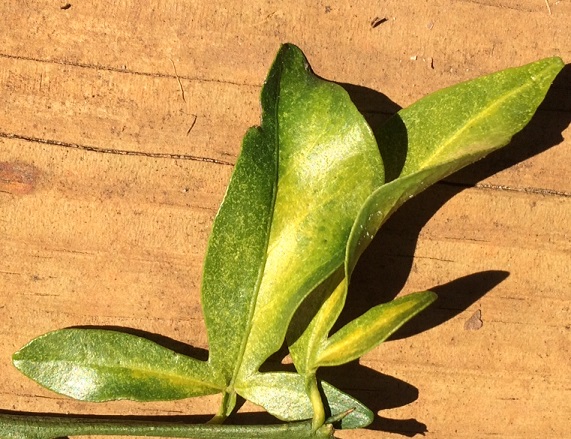

Pictures taken in January 2020 showing the yellow in the center of the leaves from Poncirus cells. 


Virginia Fruit Grower Video


Monday, January 20, 2020

Nansho Daidai, Taiwanica

Nancho Daidai sour orange

Citrus taiwanica

 'is a very hardy tree and an upright, vigorous grower with long, narrow leaves and huge spines. The fruit is large, oblate-spherical, and bright yellow. Over the years, Nansho Daidai has proven to be one of the hardiest evergreen citrus. A citrus pioneer in Montezuma, Georgia had a large Nansho Daidai that endured 0°F in 1985 without any noticeable leaf drop, and no loss of crop the next year. How much below zero this citrus can take is unknown, but it’s certainly a hardy variety. Fruit quality is only mediocre, though the fruit can be used as a lemon substitute and for making very good -ade type drinks. Hardy to 5°F easily. Flavor: Sour lemon, some off-flavors, fair quality.' (1)

Related to sour orange (2)(3)

 Depending on location and weather prior to cold events, hardy to about 5 degrees(4)

 30% of seed is zygotic

Eyeckr provided these fruit. Fruit is juicy, flavor is very similar to a bitter lemon, however when diluted and sugar added tastes like lemonade. Fruit is seedy, having 37 large seed. Large fruit, 116 gms, small fruit, 96 gms. Brix 11.9

Monday, June 12, 2017

Swamp Lemon

From cache of Citrus forum:
http://webcache.googleusercontent.com/search?q=cache:izGDY9FcFX0J:citrus.forumup.org/about3639-.html%26highlight%3D+&cd=1&hl=en&ct=clnk&gl=us

Posted: Thu Oct 09, 2008 12:42 am    Post subject: Swamp Lemon Reply with quote


Not sure if this should be listed here or roostock.

Anyway... Terry sent me some fruit with the below story attached. The fruit is the size of large Trifoliata fruit. Same look & texture. The thing is these fruit don't have the stink of standard Trifoliata. Too late to take photos, I will get some tomorrow, clean the seed and let you know what I find.

Quote:
Swamp Lemon Story


  I finally got up with the guy who has the Swamp Lemon.  What a neat old guy.  He reminded me of my grandfather. Here's what he told me so far.
    That he was 14 when he was hunting on the Livingston Creek in Delco, NC.   He saw the swamp lemon and asked he's older hunting companion about it.  His friend said that the Swamp Lemons had grown wild there on Livingston creek for as long as he could remember.  This guy Charley said that as that was 60 years ago and adding his friend’s age would make it about 125 years that these lemons were growing wild there.  
    I think the 60 years is reliable. I'm not as sure of his old friends extra 45years.  So, this Swamp Lemon has been growing there for 60 to 125 years.
    He said that most people who live in that areas have these lemon trees growing in their yard by digging them up from this creek.  But as far as I know the Swamp Lemon trees are only growing wild along the west side of Rte. 74 where it crosses the Livingston Creek.
    So I'm thinking that some one brought a fruit there from FL about 60 to 125 ears ago. The trifoliate may have been cross-pollinated from an orange.  But the fruit doesn’t look much different than trifoliate.
I am surprised that in 60 to 125 years that all of the Cape Fear river isn't covered with Swamp Lemons because Livingston Creek flows into the Cape Fear River.  The Lemon site is only about 30 miles from Wilmington. Maybe the brackish water helped.
After a lot of effort I obtained some fruit and seedlings and some cuttings.
Now here’s the thing. The fruits flesh has no trifoliate taste or smell. None at all. The peeling has a slight off smell and a gummy nature to it. It doesn’t taste good or bad it’s kind of bland. The taste is closer to an orange than a lemon but definitely citrus. I don’t know if a regular Trifoliate has a lemon or orange taste. All I remember of the one I tried to taste was the terrible smell that was nauseating. But, unlike the usual trifoliate you can eat it. I was told that some have made lemonade with it. So, I tried it. On a scale of 1 to 10 I’d give it a 5. If you live in a zone 9 or 10 it wouldn’t impress you. If you live in a zone 6 or 7 and wanted to say you drank a Trifoliate lemonade it wasn’t bad.
My question is,” If a Swamp Lemon used this to re-make some of the early trifoliate crosses do you think I would be ahead of the game taste wise? This doesn’t seem to be a soil generated taste difference. The Swamp Lemon that I got is at the least third generation from the original tree and is 10 to 15 miles from the original tree.


The flesh seems more yellow than Poncirus and the juice has an agreeable sour taste. There were Poncirus oils in the skin though, and the fruit size (external appearance) was more similar to Poncirus than citrange.

Saturday, January 16, 2016

Citrus Boards and Blogs

If you know of Hardy Citrus Boards or Blogs, send a link, thanks.


Czech:  http://www.citrusy.estranky.cz/

Czech: http://www.subtropicke-rostliny.cz/forum/viewforum.php?f=22

English and Finnish:  http://citruspages.free.fr/

English (UK):  www.homecitrusgrowers.co.uk

English (US and International): archive of citrus forumup.    It has a lot of information that cannot be found elsewhere.  Thanks to Sylvain for all his work.  

English (US): The new English site for Hardy Citrus
             http://tropicalfruitforum.com/index.php?board=14.0

English (US):  http://www.permies.com/t/20777/trees/Cold-hardy-citrus-trees

French:  http://www.agrumes-passion.com/

French: http://www.forum-agrumes.com/viewforum.php?f=13&sid=d7fa104a25a06c688b6dade0dfd6e403
German:  http://www.exotenundpalmen.de/f5-Bananen-Citrus-Palmfarne-Baumfarne-Gehoelze-Bluehendes-mehr.html

German:  http://zitrusgarten.net/

Hungarian:  https://plus.google.com/107150318774510322151/posts

Hungarian:  http://citrusfa.blogspot.hu/

Italian:  http://www.fruttama.it/forum/viewforum.php?f=10&sid=8f996a5466d05c321949830667daea24

Polish:  http://cytrusy-mrozoodporne.blogspot.com

Polish:  Citrus in general http://www.cytrusy24.pl/  Specific hardy section http://www.cytrusy24.pl/forum-cytrusowe/cytrusy-mrozoodporne/

Russian:  http://forum.homecitrus.ru/topic/18215-tcitrusovye-v-otkrytom-grunte-v-polusubtropik/

Russian (Ukraine):   http://citrusforum.org.ua/

Russian (Ukraine):   http://myflora.org.ua/forum/viewforum.php?f=4

Spanish:  http://foro.infojardin.com/forums/citricos.85/

Not a board but a small book.  Hardy Citrus of the Southeast by Tom McClendon. pdf file   Dozens of hardy citrus varieties described

Thursday, September 24, 2015

Strange plants


 Miniature plant almost 3 years old.


Diploid Poncirus top leaf, Tetraploid Poncirus bottom leaf.

Tetraploid Swingle

Natural high ploidy seedling
Leaf thick and leathery.
F2 from probable Hirado Buntan x Poncirus

Saturday, June 28, 2014

Ventura Lemandarin

Lemandarin is a cross between Citrus tiawanica x (Keraji or Satsuma) It looks like a satsuma.  Resistant to soil diseases that have killed my other seedlings.  Vigorous. 

From the breeder:  As far as hardiness my seedling Lemandarin never flinched in the cold weather until this past brutal weather. It survived at least to I think 11°F, -12°C degrees and a few 13°F and 14°F, -11 and -10°C events in the past. This winter it reached its max tolerable temp where it died at 5.5°F, -15°C on its own roots. Less than a foot away I had a back up graft of it on flying dragon about 4 feet up that defoliated with branch die back but is growing back very well. I can attest to that at least when high grafted it can at least withstand about 6°F, -14°C.

May come true from seed.

Mild lemon flavor.

Update: January 21, 2020
Eyeckr provided another fruit.  Smell is good.  Taste is excellent, like an orange with some lemon.   Brix 13.3  Peels more easily than a mandarin.  2 3/4 inch, 7 cm diameter.  3.8 oz, 108 gms. 28 seeds.  Skin bitter. 


Wednesday, May 7, 2014

Where to buy

USA:

  New:  Simply Citrus Nursery 
     In Columbia SC


All kinds of hardy citrus in SC, Stan is a great guy:  Mckenzie Farms

Huge assortment of plants grown from seed in SC: Woodlanders

Hardy Citrumelo:   Chilly Palms

Citrus in Virginia: Pungo Palms

Another Citrumelo: Logees

Eight kinds of hardy citrus in Ca: Rolling River Nursery

A few from Tennessee:  Ponds n Plants

Three mandarin in NJ:  Triple Oaks

Flying Dragon in NC: Useful Plants

Sudac and others:  One Green World

Satsumas and more: 
Hardy citrus restricted to Fl:  Just Fruits and Exotics

Yuzu and mandarin and more in Ca:  Four Winds Growers


Europe:

Czech:  Exoticke Erostliny

             Good source of information

            Adavo

 Germany:  Flora Toskana

France:  Jardinerie Riera
              La Pépinière du Bosc
              Le Monde de Agrumes Baches
           
Italy: Oscar Tintori

         AgrumiLenzi

Netherlands: Citrus BaLi

Spain:  Citrus and Life

 Switzerland:  Eisenhut

Wednesday, February 12, 2014

Changsha


Changsha is one of the hardiest of the mandarins.  May have C. ichangensis in background.  Survives short freezes of  13°F, -11°C F with no loss of leaves, reports it survives 6°F, -14°C [4] p. 28 and also dying at that same temperature [5] .  Generally considered hardy to 10°F, -12°C [4] p. 14.  It is very seedy and the flavor is bland, low acid.  Honey Changsha is a selection with better flavor, at least some seedlings are zygotic. It has about 25 seeds per fruit.


Honey Changsha


Seedless Changsha News 

In 2003 Dr. Wayne Hanna at the University of Georgia Tifton Campus started working on a seedless Changsha.[1]  He exposed seed to gamma radiation to induce sterility.  Dr. Hanna[2] and his fruit[3].  Dr. Hanna at the 2013 Citrus Expo in Alabama said it was still a couple of years away from introduction.

A seedless Changsha, cold hardy seedless lemon and seedless grapefruit is now available  
but only for sale in Georgia.

  • ‘Sweet Frost’ is an irradiated Changsha mandarin with two to three seeds per fruit. It has a Brix range of 11-12, it is very easy peel, well-colored, and matures (in GA) in November or December.
  • ‘Grand Frost’ is an irradiated Ichang lemon. This is a large lemon (25 centimeters to 28 cm in circumference) with about 8 Brix and high juice content. It has nice, bright-yellow color and a maturity range of November through January.
  • ‘Pink Frost’ is a red grapefruit, with characteristics not dissimilar to ‘Ruby Red,’ but with somewhat deeper color. It averages 30 cm to 35 cm in circumference, has Brix 8-11, and matures (in GA) November through March. It averages three seeds per fruit. This variety was identified in Georgia. It was a high seed fruit, with approximately 60 seeds before being irradiated.[4]

Tuesday, February 11, 2014

Razzlequat or Coachella Eremolemon


Citrus (Eremocitrus) glauca x ?

Hardy at least to 13°F, -11°C


There is a lot of confusion as to the origin of this variety.  It was named Razzlequat in the Oregon Exotics Catalog, which suggests one parent is a kumquat, but the catalog's author identified it as 'Eremocitrus x C. Limona Meyer'.[1]   Mislabeling continued in 'Hardy Citrus of the Southeast' Kumquat x Eremocitrus glauca[2] p.26.

Swingle called it a "Eremolemon [Eremocitrus glauca X Citrus limon 'Meyer lemon']." [3] and the UCR website takes its information from him [4]

It now appears that it is a cross with a grapefruit.[5]

Hardiness testing in Savannah Georgia showed it to be one of the hardiest varieties tested.   Surviving 13°F, -11°C with poor acclimation better than Yuzu and Ichang papeda.[6] Since Yuzu is considered to be hardy to 10°F, -12°C it should survive lower temperatures.  Perhaps it maintains dormancy longer than Yuzu and Ichang papeda when exposed to warmer weather. 

Plant is very thorny.  Flavor is sour. Very rare.


Pictures courtesy Virginia Fruit Grower
 

Virginia Fruit Grower Video


Saturday, February 1, 2014

Ten-Degree Tangerine aka Clem-Yuz 2-2 or Clem-Yuz 3-3

1/2 Clementine, 1/2 Yuzu

Citrus reticulata x (C. ichangensis x C. reticulata)

Originally thought to refer to Clem-Yuz 3-3, there is confusion and it may also refer to Clem-Yuz 2-2.

Hardy to 10°F, -12°C perhaps to 5°F, -15
°C

Ten-Degree Tangerine may refer to either Clem-Yuz 2-2 or Clem-Yuz 3-3.  Clem-Yuz 2-2 is a much earlier ripening fruit and is said to be better tasting by one grower.  Clem-Yuz 3-3 can have a kerosene aftertaste.  However Dr. Brown the originator preferred 3-3

"This plant, otherwise know as Clem-Yuz 3-3 is one of a number of Clementine X Yuzu hybrids produced by Dr. Brown during the late 1960s...semi-deciduous...blooming and fruiting after 80 to 130 hours of continuous subfreezing weather with minimum temperatures of 10 F or lower...Fruit ripens relatively late, in mid-December, in Texas, when it attains quality better than that of supermarket tangerines...the fruit matures into a sprightly flavored tangerine"[1] p. 30
“The rind is orange and smooth...If self pollinated the fruit is nearly seedless.  But otherwise has 8-20 large, plump seeds per fruit, seeds appear to be a mix of monoembryonic and polyembryonic types...unripe fruit has an excellent lime-like flavor...(fruit) will keep for several months under refrigeration.”[2] p. 48 

At the Stan Mckenzie orchard in SC in March 2014, Ten-Degree Tangerine looked much better than Owari.  Trees still had their leaves, while Owari was mostly defoliated with stem die back.   

Note on 11/13/15  Picked the only fruit on 3-3Small and immature.  Skin color half turned from green to yellow. Interior color pale yellow.  Flavor very good, tastes as good as some store bought, brix 9.5.  Fruit was cross-pollinated. 12 seed. 


Single Clem Yuz 3-3 picked on December 15, 2016.  Color is not as orange as expected based on Dr. Brown description. Skin is smooth, compare with 
2-2


December 1, 2017, picked 1 fruit.  Brix 12.  Slightly tart, but good flavor. 


Clem-Yuz 2-2

The fruit is large tangerine size...juice is sweetish with a mild tangerine flavor that has a trace of kerosene; but there is no gum or bitterness.  Each segment has 1-2 seeds which are moderately large...Although the peel is corky, it is edible because it lacks the intense acrid bitterness seen in most citrus...Fruit is borne at branch tips near the outside of the tree, and is ripe by mid-October.

At best, fruit is a pale, juicy, seedy, low-flavored mandarin, but in many years it is dry and juiceless.  Tree is productive, withstands 5 - 10 degrees F.[2]  pp. 48 & 50  


An experienced hobbiest believes this is an excellent flavored fruit,  and the early ripening period is an added benefit. Personal observation, pleasant tasting.

2-2, very loose skin, photo taken November 19, 2016

Taitri

Citrus trifoliata x C. taiwanica

Hardy to 0°F, -18°C

"A hybrid known as Tatri, of seed acquired by Bill Chapman from Dr. Soost, then at U.C Riverside, is known to be C. taiwanica x P. trifoliata, and quite hardy.  My seven in Franklin survived with only minor damage at one degree above zero, likewise one at Houston at five degrees above.  Bill Chapman agrees the juice of this hybrid is sweeter with less of the objectionable flavor than any other 50% P. trifoliata hybrid.  A recent re-test comparing Taitri#1 with Citemsweet (both were admittedly frost damaged to 23° F and only Taitri #1 had fully colored) found them quite close, indistinguishable to my taste.  No positive or negative comments arose in a taste test in Houston on November 30, 1991. "[1] p. 14

Some seeds are zygotic.


This is a mild improvement, and not directly edible.  It does have some trifoliate scent but mostly lemon fragrance from the Tiawanica and luckily the resin, funk and oils are not present like in regular trifoliate.  Being deciduous it should be hardier much further north, probably hardier than other 50% hybrids that are not trifoliate.

Saturday, January 18, 2014

Hanna Tokyo Pummelo

Citrus grandis (maxima) 'Hanna Tokyo'

Hardy to 10°F, -12°C 

There is one pummelo (pomelo, pommelo) that has been known to survive 0°F, -18°C degrees and come back. The Tokyo Pummelo, a.k.a. Hanna Pummelo, was brought back from Japan in the early 1980's by Dr. Wayne Hanna by way of seed. The mother plant was covered in snow and was full of fruit which caught his attention. He sent seed back to himself and planted it in his yard. Although a very vigorous grower it was set back some years ago after it froze back in 0°F, -18°C weather.

Fruit is the size of a grapefruit, mild flavor.

Thursday, January 16, 2014

Sanford Curafora

(Poncirus x Orange) x mandarin?

1/4 poncirus, 1/4 orange, 1/2 mandarin
or 
1/4 poncirus 1/2 orange, 1/4 mandarin
(Citrus trifoliata x C. sinensis 'Ruby') 'Sanford' x C. reticulata?   


Hardy to 17°F, -8°C, or 10°F, -12°C 

Sanford Curafora  is a seedling of an open pollinated Sanford Citrange.  It was selected by Dr. Edwin Frey of Switzerland. The pollen parent is unknown, it is obviously a kind of mandarin, and Bernhard Voss has suggested it is a Clementine.  The whole habit of the plant is mandarin like. The leaves are thin, dark green and attractive, more long than broad and look like mandarin leaves, except for some bi- and trifoliate leaves that sometimes occur. Young growth is frost tolerant. 
Tree sets flowers abundantly, fruits should be thinned,  otherwise it will get only male flowers the next year. The flowers are very fragrant and look more like citrus flowers than Poncirus. The stamens stand free as in Poncirus. They have a lot of pollen and also plenty of nectar.  Perhaps self incompatible, but will set seed with other pollen, indicating perhaps male parent was Clementine. Fruit is  juicy, sweet and with good Clementine aroma. Peel-ability varies. No Poncirus taste. Fruit are late ripening, as late as March, but may be picked as early as December in warmer climates. Similar information plus photographs [1

Clementine is either a tangor (orange x mandarin) or  mandarin [2]
When grafted in August, or later, first growths are flowers.  Plants are slow growers.


More comments from May 14, 2014 [3]

Monday, January 13, 2014

Cold Hardiness Table


After a severe winter with a low of 6 F, -14.4 C, Eyeckr reported on the condition of his plants.[1]  This table is derived from his report.  Many thanks for this invaluable information.


3/27/17:
After an extended warm period which saw some citrus setting out new growth, the temperature dropped to 21 F on 3/16/17.  Most citrus saw death of older leaves, in an erratic pattern.  In semi order of hardiness, from high to low.

LEAVES RETAINED:
MIC
Taichang Lemon
Clem-Yuz 2-2
Calamandarin
Nippon Orangequat
Morton
Ventura Lemandarin
Changsha
Thomasville Citrangequat

MIXED:
Juanita
Sunki Kat Mandarin
Ci Clem 10 Golden Lime
SRA 92

LEAVES LOST:
Kimbrough
Taiwanica
Shekwasha
Panzarella Orange
Clemnule
Sancitchang
Ujukitsu
Glen Citrangedin
Hanna Tokyo Pummelo

These results indicate that the plants which remained dormant longest are the most resistant to damage.

Varieties not included here are those that are deciduous or semi-deciduous

And finally,
Comparing Yuzu with Ichang papeda, Yuzu is hardier, Ichang had stem die back and is less vigorous.
These are just basic observations based on small numbers of plants and limited cultural conditions.  Other years/conditions might yield different results.


Extensive list of cold tolerant citrus  Poncirus  data is wrong